
Sewage, Sex, and Sickness in the Five Points
by Steve Clopper
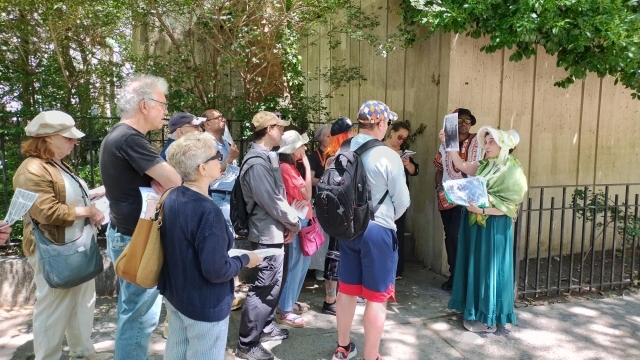
Suzanne Reisman brought to life an undercounted era of New York City history. Her tour did not simply describe the Five Points as a notorious slum; it allowed us to enter an erased landscape and imagine the people who once lived there. In present-day Chinatown, where redevelopment, new streetscapes, storefronts, and civic buildings have swept away much of the old neighborhood’s physical evidence, Suzanne gave shape to what is no longer visible.
At times, she seemed to speak almost as an anonymous figure from the past: not a celebrity, politician, or reformer, but one of the countless people whose lives made up the real history of the Five Points. Through her storytelling, the vanished district became legible again. We could begin to sense the former streets, crowded rooms, unstable buildings, polluted water, foul smells, sickness, vice, poverty, and survival that once defined this part of Lower Manhattan.
What made the tour especially powerful was the way it treated the neighborhood as a kind of ghost landscape. The old Five Points has been cleaned, renamed, rebuilt, and absorbed into the modern city. Yet Suzanne showed that the past has not entirely disappeared. It lingers beneath the present-day surface: in the street grid, in the surviving tenement forms, in the memory of Collect Pond, in the history of reform and demolition, and in the moral language outsiders once used to describe the “poorest of the poor.”
Her interpretation helped us see beyond the sensational reputation of the Five Points. Sewage, sex, and sickness were not merely lurid topics; they were windows into how people lived under intense pressure. The tour connected bodily realities — smell, disease, overcrowding, hunger, desire, work, and death — to larger urban systems: housing, sanitation, policing, immigration, public health, and redevelopment.
As guides, we are often asked to explain places that no longer look the way they once did. Suzanne demonstrated how to do that with imagination, research, and restraint. She made the invisible city visible again. Through her narration, the Five Points became a ghost we could see, sense, and almost smell, allowing the past to come vividly back to life without reducing the people who lived there to spectacle.